A Children’s Catechism Curriculum for Home, Homeschool, and Church
/When I first started teaching the Children’s Catechism to my own kids, I knew I wanted to do more than simply ask the questions and have them memorize the answers.
I wanted them to know the answers, of course. There is real value in giving children clear, precise words for what they believe.
Who made you?
God.
Why did God make you and all things?
For his own glory.
Are there more gods than one?
There is only one God.
Simple answers. Very big truths.
But I also wanted my kids to understand what those answers meant.
I wanted us to open our Bibles and see where these truths came from. I wanted to talk about words like glory, covenant, regeneration, justification, and sanctification. I wanted to sing the questions until the answers became familiar. And sometimes I wanted to pull out the paint, scissors, or clay and keep talking about theology while everybody’s hands were busy.
So I started creating Children’s Catechism lessons for my own family.
This project started a long time ago
If you have been around Reformed Mama for a while, you may remember some of those early Children’s Catechism posts.
Realistically, though, it was hard to keep up with them.
I was planning the lessons, teaching them to my own children, finding Scripture passages and music, coming up with activities, taking pictures, and then trying to turn everything into a blog post.
All while actually raising little kids. If you are in that season right now, I remember the exhaustion well. And eventually, the blog series slowed down. My kids kept growing. We moved across the country to go to a new church.
Now that they are older, I decided to circle back and finish what I started. I wanted to take those early lessons, fill in all the gaps, rethink and expand them, organize everything, and create the resource I wish I could have handed myself when my children were little.
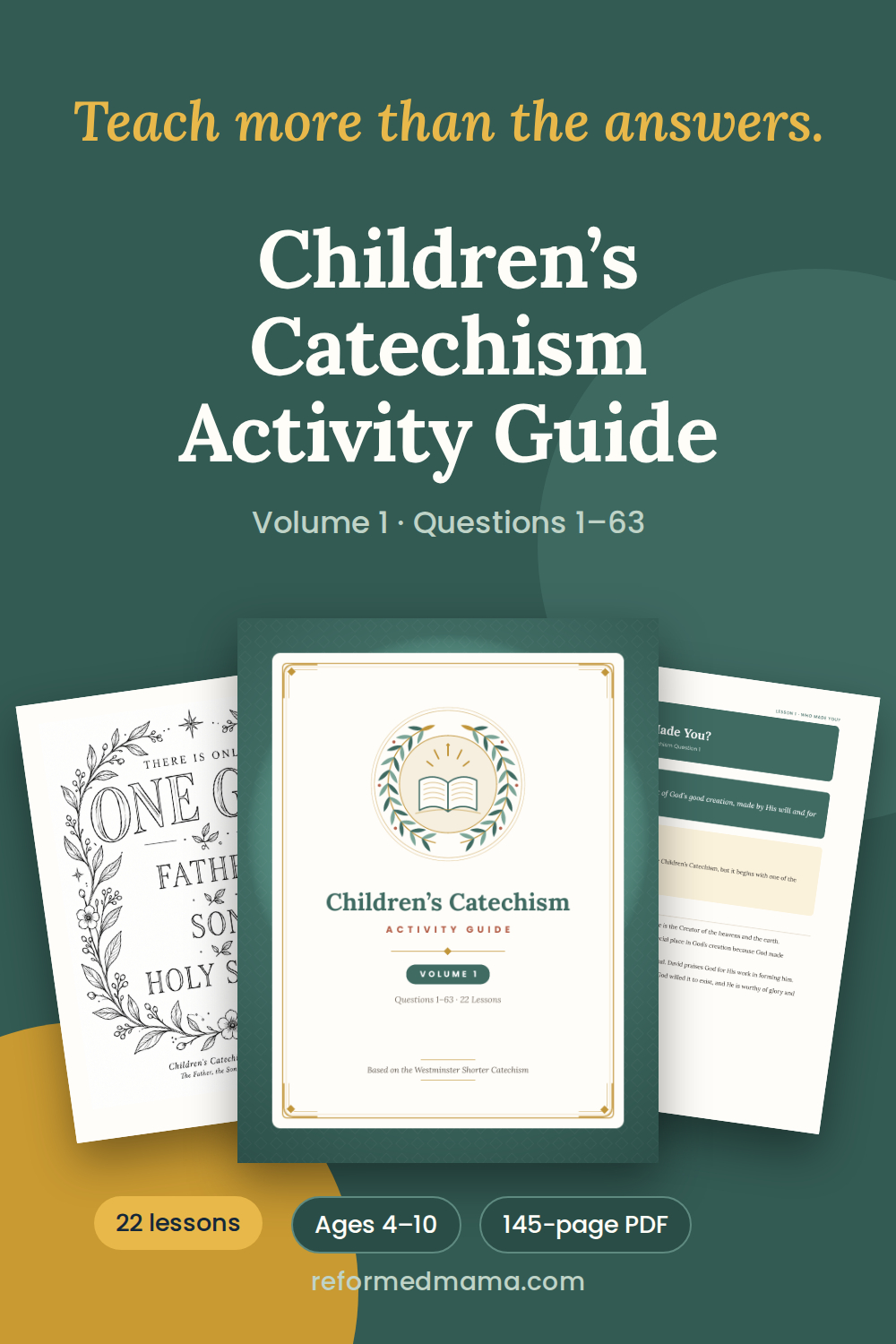
That became the Reformed Mama Children’s Catechism Activity Guide, Volume 1: Questions 1–63.
And I hope I get to use it again myself someday, whether with children at church or, Lord willing, with my own grandchildren.
Teach more than the answers
I absolutely want children to memorize the catechism.
There is enormous value in putting good theological language into their minds while they are young.
But memorization is not the finish line. I want children to see that these answers come from Scripture.
I want them to understand that theology is not simply a collection of difficult words adults discuss somewhere else. Theology tells them who God is, who they are, what went wrong with the world, why they need a Savior, and what God has done to save His people.
And I want parents to have enough help to actually talk about those things with their children.
That is what this guide is designed to do.
What does Volume 1 cover?
Volume 1 includes 22 ready-to-use lessons covering Questions 1–63 of the Children’s Catechism.
The lessons begin with the foundational truths that God made us and all things for His glory. From there, children learn about the Trinity, God’s character, Scripture, Adam and Eve, body and soul, the covenant of works, sin and the Fall, original sin, regeneration, the covenant of grace, Christ’s perfect obedience and atoning death, justification, sanctification, repentance, faith, and the Savior God promised.
That is a lot of theology.
But one of the things I love about catechism is that children can begin learning the words long before they fully understand everything those words contain.
A five-year-old does not need to give a seminary-level explanation of justification.
He can learn the word. He can learn the catechism answer. He can hear the Bible.
Over the years, Scripture, sermons, conversations, Sunday school lessons, and ordinary Christian life begin filling those words with more and more meaning.
What is inside each lesson?
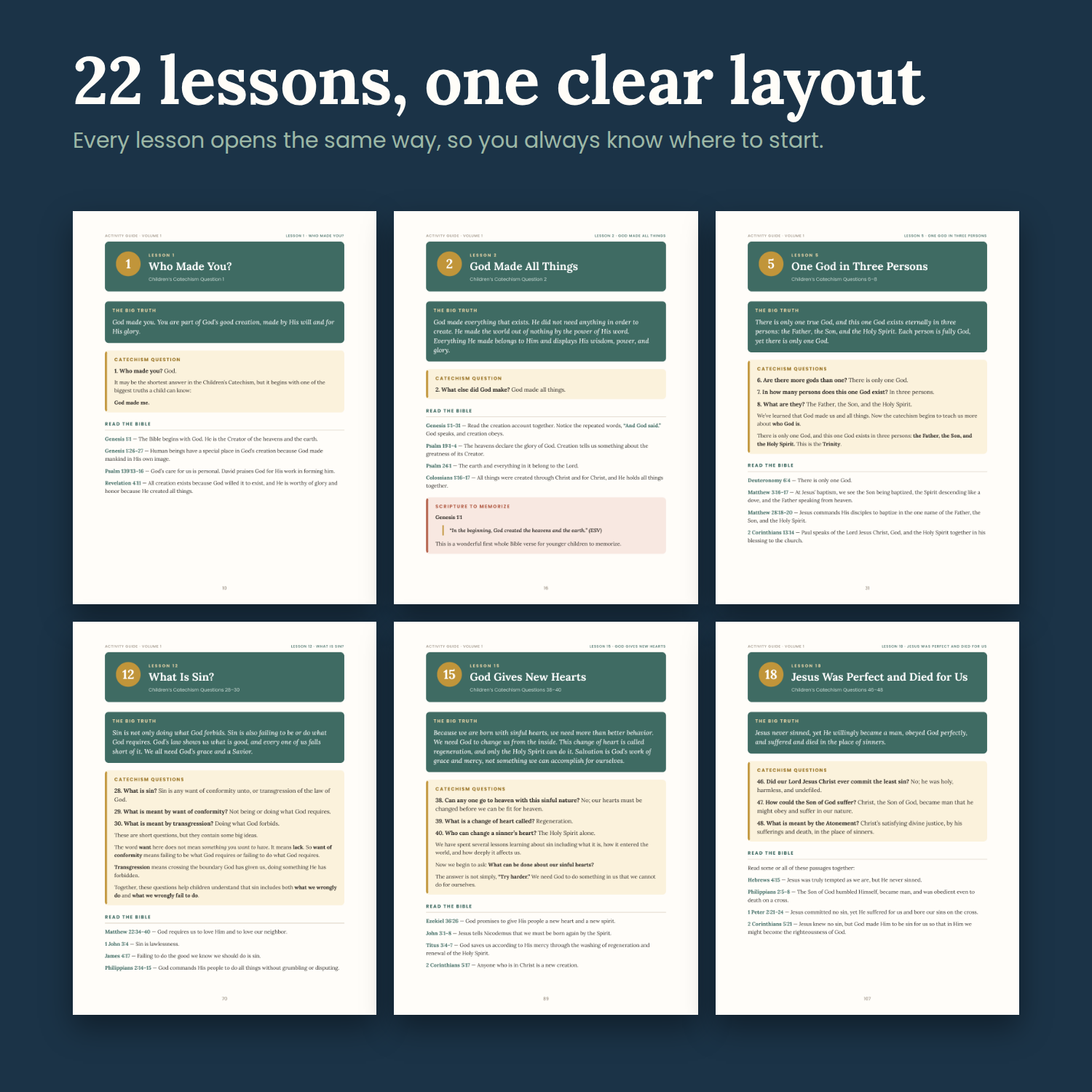
The guide follows the same basic rhythm from lesson to lesson, so it quickly becomes easy to use.
Each lesson may include:
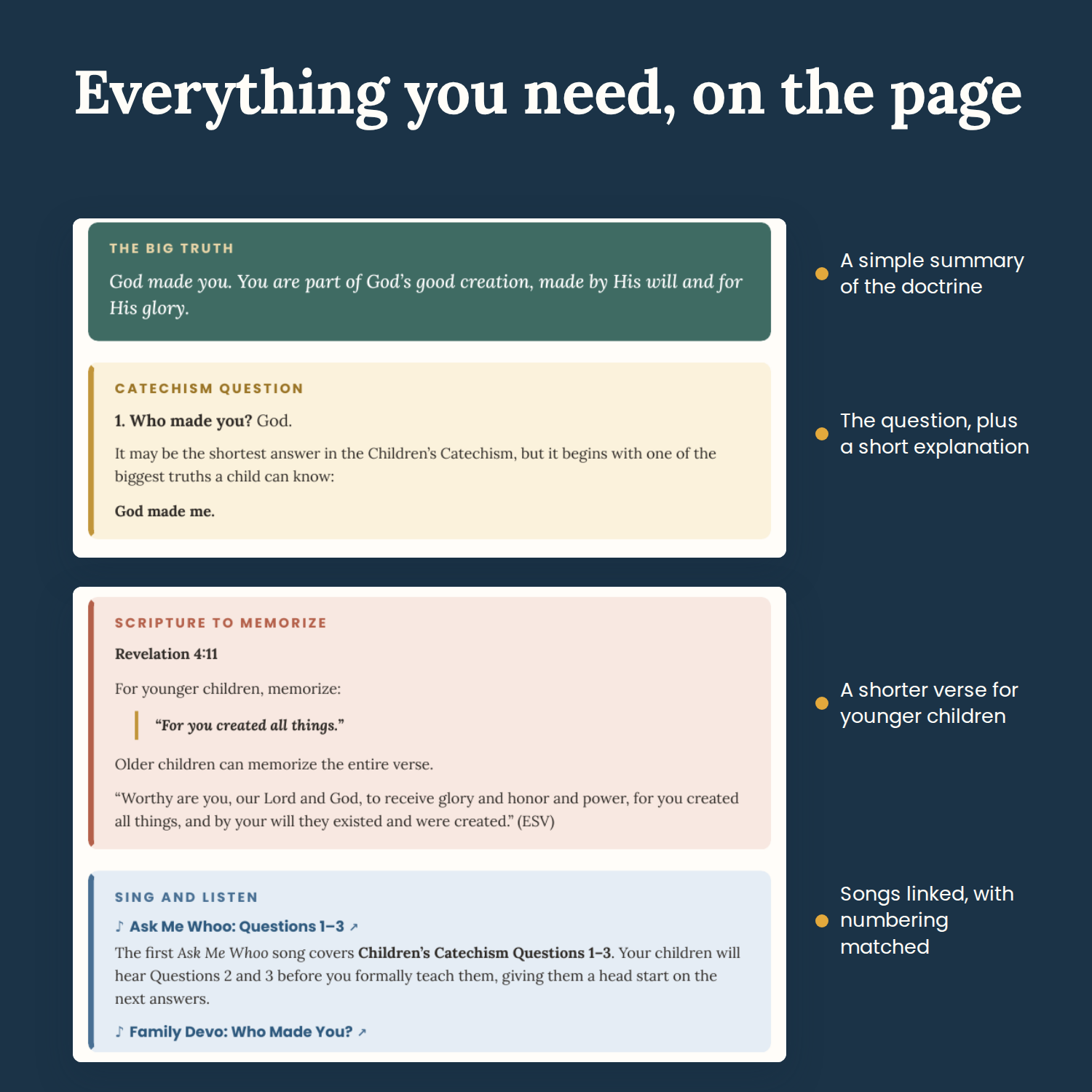
The Big Truth, a short summary of the doctrine being taught
The Children’s Catechism questions and answers
Carefully chosen Bible passages
Scripture memory, often with a shorter portion for younger children
Direct links to catechism songs and other music
Optional readings from favorite children’s theology books
Conversation prompts
Hands-on activities, art projects, games, or printables
Go Deeper notes for parents and teachers
Catechism review ideas
Prayer prompts
The goal is to give you plenty to choose from without making you feel like you have to use all of it.
Because you don’t.
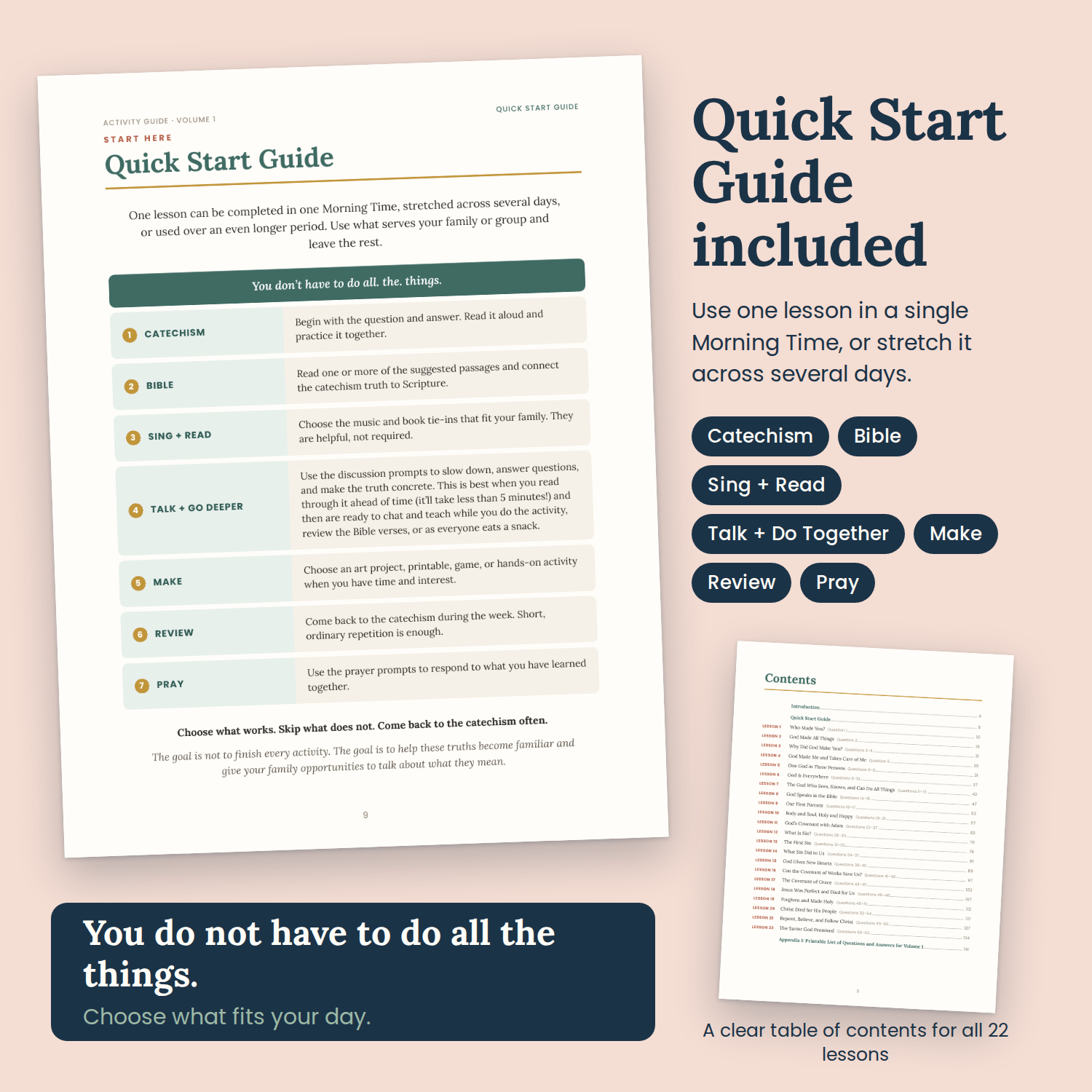
You do not have to do all. the. things.
This may be the most important thing I can tell you about the curriculum.
You can absolutely use one lesson during a single Morning Time.
Read the catechism questions. Listen to the songs that go with them. Open the Bible together. Choose a few discussion prompts or another piece that fits your time.
And you have done the lesson.
Or you can slow down and spend several days on it.
Practice the questions at breakfast. Listen to the songs in the car. Read one of the Bible passages another day. Pull out an activity one afternoon. Talk about a discussion question while everyone eats a snack.
You can spend a week on a lesson. You can spend longer. The activities are options, not a checklist.
Can I use this with several ages together?
Yes.
The guide is designed primarily for ages 4–10, but it works especially well when younger and older siblings are learning together.
A preschooler might learn the catechism answer, listen to the song, memorize a short portion of Scripture, and color or paint.
An older elementary child can read more Scripture, memorize the full selection, participate more deeply in discussion, and begin making connections between the catechism and larger theological ideas.
You are all learning the same truth together without expecting exactly the same thing from every child.
This works outside of homeschool too
Although I originally created these lessons with my own family in mind, the finished guide can also work well in Sunday school, homeschool co-ops, church groups, or other small-group settings.
Choose the catechism questions, Bible reading, songs, and discussion prompts that fit the time you have.
If you are teaching a group, you can add one of the activities or printables when it makes sense.
The guide is intentionally flexible enough that you do not have to recreate the entire curriculum to fit a 45-minute class.
Yes, there are activities. But this is not a craft curriculum.
I love giving children something to do with their hands while we talk.
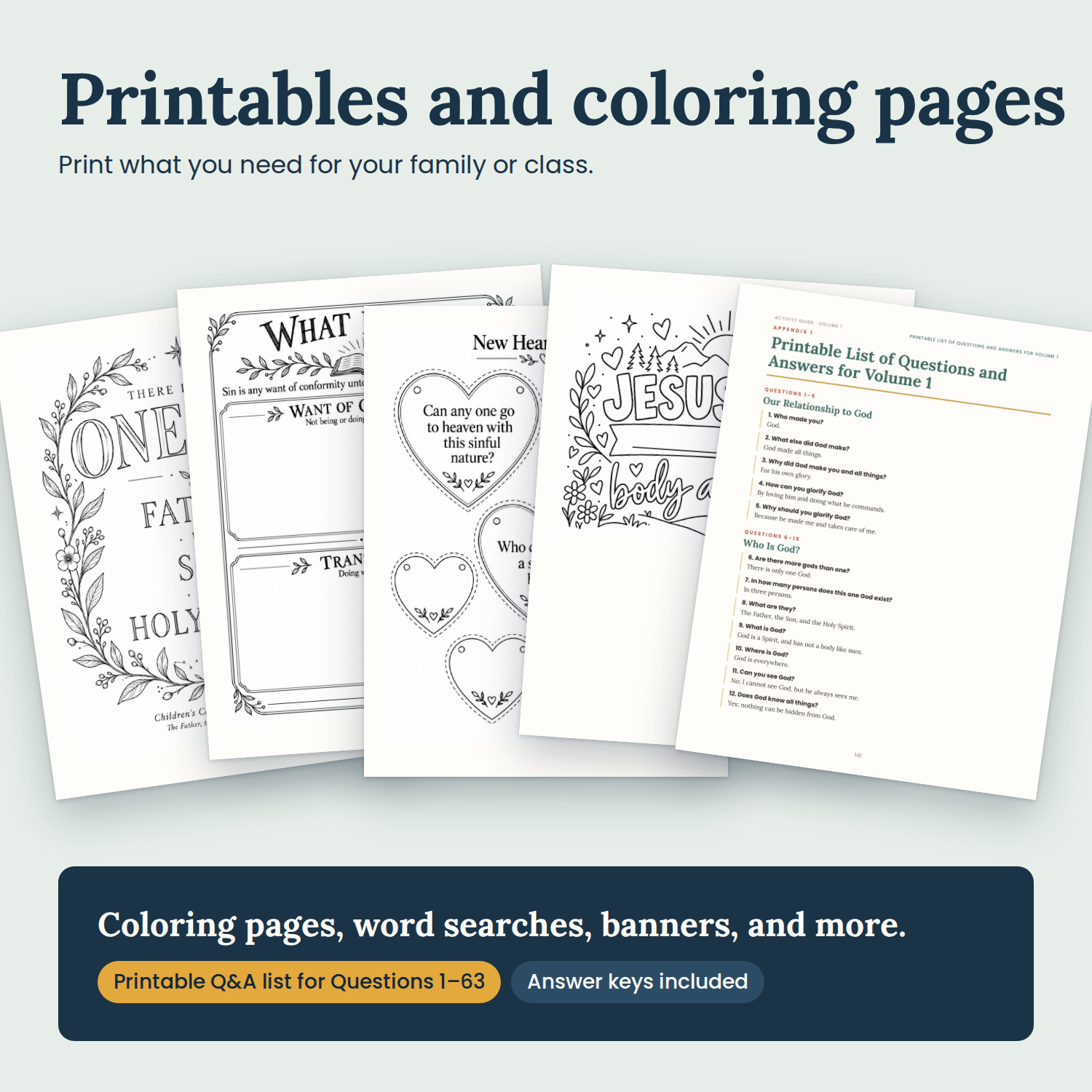
So throughout the guide you will find coloring pages, printables, art projects, games, demonstrations, sorting activities, banners, word searches, and other hands-on ideas.
But I have tried very hard not to turn every theological truth into a cute object lesson.
Sometimes the activity helps make an abstract idea more concrete.
Sometimes it gives children something enjoyable to do while you keep talking.
I solved one Children’s Catechism problem for you
If you have ever tried to use several Children’s Catechism resources together, you may have discovered that the question numbers do not always match.
This guide follows the 1840 Children’s Catechism numbering and wording.
But some of my favorite resources, including Ask Me Whooo and Big Truths for Little Kids, follow the Great Commission Publications version of the catechism.
That means you can be working on Question 40 in one resource and discover that the corresponding song has a completely different question number.
I went through and matched those for you.
When an Ask Me Whooo track corresponds with the questions in a lesson, I have linked the correct song to YouTube so you can just click and listen.
When a chapter from Big Truths for Little Kids or The Ology fits especially well, I have already identified it.
You do not have to sit there with several books open trying to figure out which numbers line up.
You can just teach.
If you want to see the optional books and music I use throughout the curriculum, I also put them together here:
What do I need to use the curriculum?
A Bible.
And the guide.
That’s it.
The books I recommend throughout the lessons are completely optional. If you already own them, wonderful. I tell you exactly where they fit. If you don’t want to buy them right now, skip those sections and keep going (or see if you can get it from your library or borrow from a friend!). All the music is available for free on YouTube.
What about the free Children’s Catechism resources on Reformed Mama?
They are staying.
I want to be especially clear about this because they still get quite a bit of traffic. I am not putting the old posts behind a paywall or even an email subscribe button. If you need a free lesson or printable, use it.
If you find one of my old catechism posts through Google or Pinterest, I hope it helps you!
The paid Activity Guide is for the person who looks at all of those individual resources and thinks: I wish someone would just put all of this together for me.
That is what I finally did!
The guide is not simply a collection of old blog posts copied into a PDF.
I went back through the material, completed the unfinished portions, expanded the teaching, organized everything into 22 lessons, added Scripture memory, matched songs and books, wrote discussion prompts, created and updated activities and printables, added Go Deeper teaching notes, built in review and prayer, and made it all work together as one curriculum.
You are paying for the finished, organized, ready-to-teach version.
And, as a former mom-of-little-kids who knows exactly how precious your planning time is, I think that matters.
Want to see an entire lesson first?
I would.
So I made a free sample too!
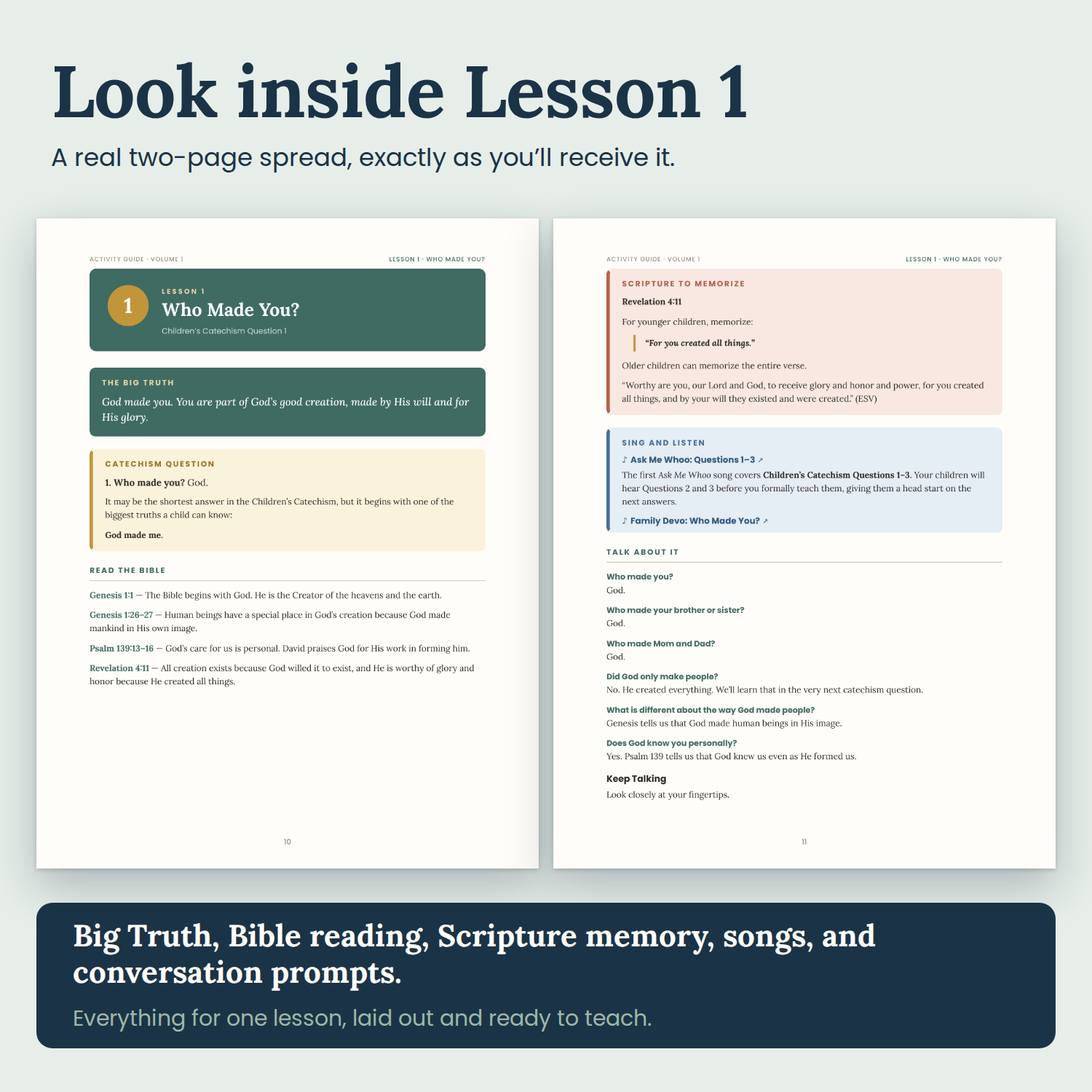
The sample includes the Quick Start Guide and the complete first lesson, “Who Made You?”
It is not three random preview pages.
You can actually download it, sit down with your children, and teach the first lesson.
You will be able to see the catechism question, Bible readings, Scripture memory, songs, discussion, activity, Go Deeper section, review, and prayer prompts before you decide whether the full curriculum is right for you.
A note for the parent who feels unqualified to teach theology
Some catechism questions are wonderfully simple. Others introduce doctrines Christians spend their entire lives understanding more deeply. That can feel intimidating.
But you do not need to explain everything at once.
Teach the answer. Read the Bible. Answer the questions your children actually ask. Use the Go Deeper section when it helps. And then trust the Lord to do what you cannot.
His Word is living and active. Pray that the Holy Spirit will use the truths your children are hearing to work in their hearts. One of the wisest pieces of parenting advice I ever received was that I do not need to have all the words. I do not have to explain every doctrine perfectly or know exactly what to say in every conversation. My job is to faithfully put God’s Word before my children, answer what I can, keep pointing them to Christ, and trust the Holy Spirit to do what only He can do.
A curriculum cannot change a child’s heart. A catechism cannot change a child’s heart. But both can help us faithfully put good words, good questions, and, most importantly, God’s Word before our children again and again.
That is what I hope this guide helps you do.
Ready to begin?
The Reformed Mama Children’s Catechism Activity Guide, Volume 1 includes:
145 pages.
22 complete lessons.
Questions 1–63.
Recommended primarily for ages 4–10.
Use it for Morning Time, family discipleship, homeschool, Sunday school, co-op, or another small-group setting.
Use a little. Use a lot.
Move quickly. Take your time.
You do not have to do all. the. things. Just start.
Children’s Catechism Activity Guide, Volume 1: Questions 1–63 for $24.99